The Checker Maven
Capers on the Kelso, Part 2
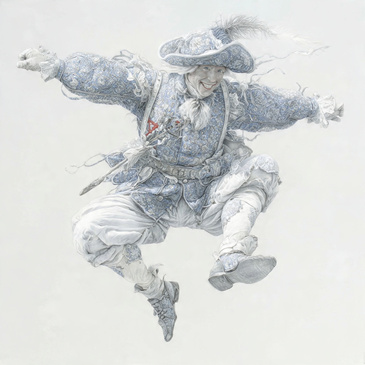
The assorted meanings of the word "caper" intermingle in our columns with various "capers" on the 10-15 Kelso opening. The photo above is the computer's idea of a Morris Dancer executing a caper, or leap.
Back in the world of checkers, though, we continue our series drawn from Willie Ryan's Tricks Traps and Shots of the Checkerboard. Recall that Willy was looking into variations ("capers") that occur some little way into the opening. For the sake of convenience, we'll repeat the full run-up (without the notes).
| 1. | 10-15 | 22-18 |
| 2. | 15-22 | 25-18 |
| 3. | 11-15 | 18-11 |
| 4. | 8-15 | 21-17 |
| 5. | 4-8 | 17-13 |
| 6. | 9-14 | 29-25 |
| 7. | 6-10 | 24-20 |
| 8. | 1-6 | 28-24 |
| 9. | 8-11 | 23-19 |
| 10. | 15-18 | 26-23 |
| 11. | 14-17 | 23-14 |
| 12. | 17-21 | 32-28 |
| 13. | 10-17 | 19-16 |
| 14. | 12-19 | 24-8 |
| 15. | 3-12 | 28-24 |
| 16. | 7-11 |
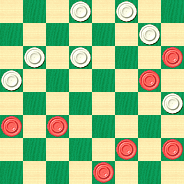
Willie now goes on in Note P, "Mr. Banks saw his chance for a draw and went after it. However, he grossly underplayed his position. I was in trouble. After the game I pointed out to him that he could have worried me by playing 27-23, leaving black in the plight indicated on the diagram shown on the next page. After a few trial runs, I managed to demonstrate a narrow draw for black, which is replete with tactical brilliancies."
This brings us to our problem position (after 27-23).
BLACK
Black to Play and Draw
B:W31,30,25,24,23,20,13:B21,17,12,11,6,5,2.
The problems in the latter part of Willie's book certainly aren't easy, but they are good, and this is no exception. Cavort with it a little and then scoot your mouse to Read More to see the solution and notes.
You can email the Webmaster with your comments on this article.
Elegant New Problems in the Offing
We're talking about checker problems, of course, and not the nonsensical math problem above, as Mr. Bill Salot continues his series of checker problem composition contests, with the next round starting today, November 28, 2014. Be sure to visit this link to view the problems, try them out, and vote on the one you think is best.
You can email the Webmaster with your comments on this article.
Thanksgiving 2014
Stockvault.net CC0
We say it year after year, and we'll say it again. We love the Thanksgiving holiday, with its American spirit, its interdenominational theme, and its emphasis on family, gratitude, and peaceful celebration. We hope your Thanksgiving will be filled with happiness and become the source of great memories for the years ahead.
We won't break our habit of turning to great American problemist Tom Wiswell for our Thanksgiving week problem, either. Mr. Wiswell, in addition to being a great checkerist and problem composer, epitomized the best of what makes America what it is.
Mr. Wiswell called this problem "All's well that ends well" and that seems most fitting.
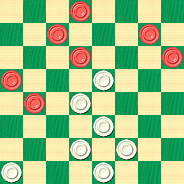
WHITE
White to Play and Draw
W:W15,18,23,26,27,29,31:B2,6,8,10,12,13,17.
Solve Mr. Wiswell's intriguing problem, then treat yourself to our usual Thanksgiving recommendation: a little more of that delicious pumpkin pie.
You can email the Webmaster with your comments on this article.
Solve This, Not That
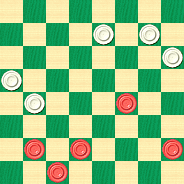
In today's Checker School column, it looks like there are two problems, and that's sort of true; what happens is that the first problem evolves into the second. So you might be well advised to take on the second problem first, and then go back and see how the first problem can indeed become the second.
Confusing? Just take our word for it and solve the problems in reverse order.
WHITE
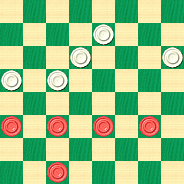
BLACK
Black to Play and Win
B:W26,23,21,20,19:B12,11,10,9,3.
WHITE
BLACK
Black to Play and Win
B:W26,25,21,20,16:B14,8,7,5,3.
What's fascinating about this is that at a quick glance, the first problem actually looks like it might be simpler!
Solve one or both, or neither(!) as your inclination and checker prowess allow, but definitely click on Read More to see the solutions, detailed notes, and a sample game.
You can email the Webmaster with your comments on this article.
Push 'Em Back
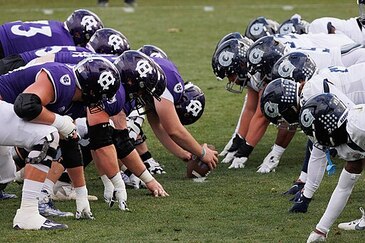
"Push 'Em Back" is a rallying cry urging your team of choice to defend the goal line in the game of American football. The Checker Maven staff are certainly not football fans, but we thought of this expression when reviewing the problem presented below.
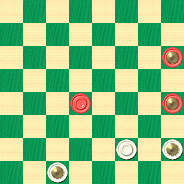
WHITE
White to Play and Win
W:WK30,K28,27:BK20,18,K12.
It's definitely on the easier side, and the title provides a rather large hint. You're invited to tackle this one; don't punt on it. Find the solution and then click on Read More to check your answer.
You can email the Webmaster with your comments on this article.
Make Haste Slowly
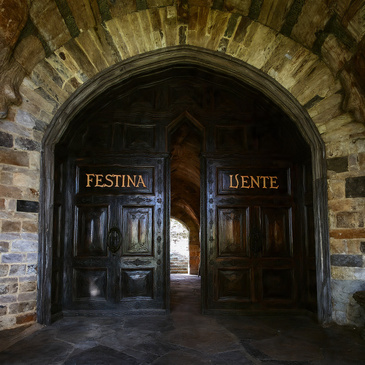
"Make haste slowly" is a saying that comes from the original Greek σπεῦδε βραδέως (we hope your browser displays Greek characters properly) but is better known in the Latin translation, festina lente.
We've always found the concept of "making haste slowly" to be rather interesting. What does it mean, exactly? Does it admonish us to hedge our bets? To proceed directly but with caution? To hurry up and wait?
Adages are often like that; they can mean any number of things.
This month's speed problem may perhaps clarify "making haste slowly," at least from the point of view of the game of checkers. While you need to solve the problem within the time limit of 20 seconds, you will have to carefully visualize and work out the sequence of moves, and that will take the typical checkerist a little time (though certainly not all that much time).
Click below to display the problem and start the clock, then come back and click on Read More to verify your solution.
November Speed Problem (Not so hard; 20 seconds)
You can email the Webmaster with your comments on this article.